
10 Best Things to Do in Polonnaruwa, Sri Lanka
A complete 2026 guide to the things to do in Polonnaruwa — Sri Lanka's second ancient capital, with the Gal Vihara rock carvings and a compact ruin field made for exploring by bicycle.
Things to Do in Polonnaruwa: Sri Lanka's Second Ancient Capital
Polonnaruwa became Sri Lanka's capital after Anuradhapura fell to invasion in 993 AD, and reached its peak under King Parakramabahu I in the 12th century, who built much of what survives today. UNESCO listed the ancient city as a World Heritage Site in 1982, and unlike Anuradhapura's sprawling, centuries-deep layers, Polonnaruwa's ruins are compact enough to see properly in a single day — a garden city with royal palaces, temples and a giant man-made reservoir all within a tight, cyclable radius.
The things to do in Polonnaruwa centre on the Quadrangle, a cluster of temples and shrines at the heart of the site, and Gal Vihara — four Buddha statues carved directly into a single slab of granite, widely considered among the finest examples of ancient Sri Lankan sculpture. Forest surrounds much of the ruin field, with monkeys and peacocks roaming freely between the stones.
Most visitors pair Polonnaruwa with Sigiriya, Dambulla or a Minneriya safari as part of a wider Cultural Triangle loop, rather than treating it as a standalone multi-day stop. If you have extra time, it also pairs well with a stop at Anuradhapura, the older capital it succeeded. UNESCO's official listing for the Ancient City of Polonnaruwa has more on its history and inscription.
Top Things to Do in Polonnaruwa: 8 Must-See Attractions
The landmarks that make the things to do in Polonnaruwa worth a full day cycling the ruins.
Gal Vihara
Four Buddha statues — seated, seated again in a smaller pose, standing, and reclining — all carved from a single continuous slab of granite, widely regarded as the finest surviving example of ancient Sinhalese rock sculpture. The scale and precision of the carving, especially the 14-metre reclining figure, tends to be the highlight most visitors remember longest.
Royal Palace of Parakramabahu
The remains of a seven-storey royal palace built between 1153 and 1186, with walls up to three metres thick still standing at the base. Nearby, the Council Chamber's stone-carved elephant frieze and lion-topped columns hint at the scale the complex once had.
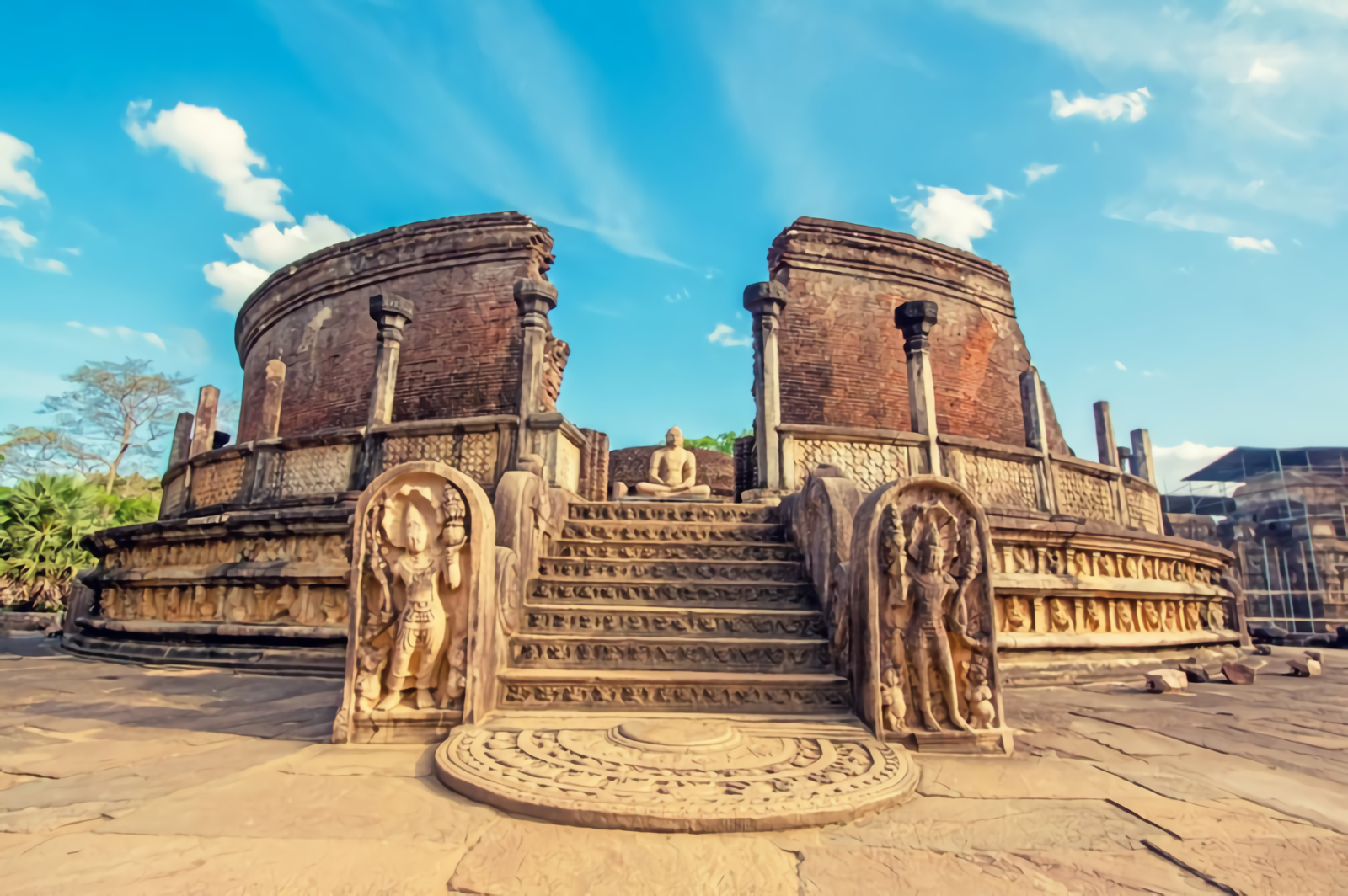
Polonnaruwa Vatadage
A circular structure built to shelter a relic of the Buddha's tooth, with four seated Buddha statues facing outward and finely carved stone entrances on each side. Considered one of the best-preserved examples of this uniquely Sri Lankan architectural form, and the centrepiece of the Quadrangle complex.
Rankoth Vehera
The largest stupa in Polonnaruwa and the fourth-largest in Sri Lanka, built in a stepped pyramidal form unusual among the country's dagobas. Its scale is best appreciated from a short distance back, where the full brick dome comes into view above the surrounding trees.
Parakrama Samudra
An enormous man-made reservoir built by King Parakramabahu I, still supplying irrigation water to surrounding rice paddies today — a reminder that Polonnaruwa's ruins sat within a functioning agricultural civilisation, not just a ceremonial capital. The bund makes for a pleasant walk, particularly at sunset.
Lankatilaka Temple
A towering brick image house with walls still standing several storeys high, built to hold a standing Buddha statue — much of which survives despite the loss of its head. The scale of the brickwork alone makes it one of the more visually striking ruins in the complex.
Polonnaruwa Archaeological Museum
A well laid-out museum with scale models of the ancient city's key buildings as they would have looked, alongside statues, jewellery and artefacts recovered from the site — a genuinely useful stop for putting the ruins in context before or after cycling through them.
Shiva Devale Ruins
Several Hindu temple ruins built by the Chola dynasty during their earlier occupation of the area, predating Parakramabahu's Buddhist monuments. A reminder that Polonnaruwa's history includes both Buddhist and Hindu chapters, not just the more heavily promoted Sinhalese kingdom.
More Things to Do in Polonnaruwa: Ruins & Local Life
The quieter things to do in Polonnaruwa that fill out a longer visit.
Cycling the Ancient City
Bicycle rental is widely available and the standard way to see Polonnaruwa — the site is compact enough that a full loop of the main ruins takes just a few hours by bike, far more atmospheric than a car.
Gal Pota
The largest stone inscription found in Sri Lanka, a massive slab covered in ancient script detailing the achievements of King Nissanka Malla, said to have been dragged nearly 100km to its current location.
Potgul Vihara
An unusual circular building believed to have functioned as an ancient library, tucked away in a quieter part of the site with far fewer visitors than the main Quadrangle.
Wildlife Among the Ruins
Toque macaques and peacocks roam freely through the archaeological park, often posing right beside centuries-old carvings — keep food out of sight around the monkeys.
Sunset at Parakrama Samudra
The reservoir's bund offers wide, open views over the water, with fishing boats and birdlife adding movement to an otherwise still evening scene.
New Town Polonnaruwa
The modern town sits right alongside the ruins, with shops, restaurants and guesthouses within easy reach — useful for a lunch break between the northern and southern sections of the site.
Day Trips from Polonnaruwa
Polonnaruwa's position in the Cultural Triangle makes it a strong base for these excursions.
Minneriya & Kaudulla National Parks
Elephant safari parks within easy reach, home to "The Gathering" — one of the largest wild elephant congregations on Earth, roughly July to October.
Sigiriya Rock Fortress
The Lion Rock fortress, a natural pairing with a Polonnaruwa visit as part of a Cultural Triangle loop. See our full Sigiriya guide.
Dambulla Cave Temple
The Golden Temple's ancient cave shrines, roughly 1.5 hours away. See our full Dambulla guide.
Suggested Polonnaruwa Itineraries
Three ways to fit the best things to do in Polonnaruwa into a Cultural Triangle trip.
Half-Day
Full Day
2 Days
Polonnaruwa Travel Tips
What to know before you go, so you can fit in more things to do in Polonnaruwa without wasting time.
1Best Time to Visit
November to April offers the most reliable dry weather. Much of the site is unshaded, so an early start — ideally before 9am — makes the cycling far more comfortable.
2Cycle Rather Than Walk
Unlike Anuradhapura, Polonnaruwa is compact enough to cover fully by bicycle in a single morning. Rentals are widely available near the entrance, and it's genuinely the best way to experience the site.
3Dress Code
Covered shoulders and knees are required at religious sites, with shoes removed before stepping onto stupa or temple platforms. Bring socks for the hot stone surfaces.
4Getting There
For visitors basing themselves in Sigiriya, Dambulla or Habarana, a private driver makes Polonnaruwa an easy add-on day trip rather than requiring a separate overnight stay.
Things to Do in Polonnaruwa: Frequently Asked Questions
Quick answers to the questions first-time visitors ask most about things to do in Polonnaruwa.
A rock temple in Polonnaruwa featuring four Buddha statues — seated, seated in a smaller pose, standing and reclining — all carved from a single slab of granite, widely regarded as a masterpiece of ancient Sri Lankan sculpture.
Typically around US2–15 for foreign visitors, covering entry to the main archaeological park.
They're different rather than better or worse — Polonnaruwa is more compact and easier to cover in a single day, while Anuradhapura is older, larger and more spread out. Many visitors do both if time allows.
A half-day covers the main highlights; a full day by bicycle lets you see the wider site at an unhurried pace, including some of the quieter ruins away from the Quadrangle.
It's possible but a long day — the two sites are just over an hour apart, so pairing them means limiting time at one or both.
Yes — the roads within the archaeological park are quiet and well-suited to cycling, with clear paths connecting the main sites.
Generally not, but they're accustomed to visitors and will investigate open bags for food, so keep bags closed and avoid feeding them.
Ready to Explore the Best Things to Do in Polonnaruwa?
Book a private driver to cover the ancient city, the safari parks and the rest of the Cultural Triangle at your own pace.